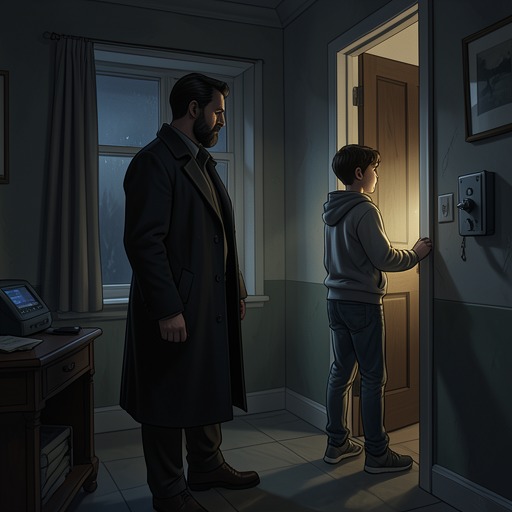
Billy receives a sealed indictment
The AxBilly receives a sealed indictment after a court proceeding that separates his burglary case from Jim Bucklin’s and gives him a conditional route away from a felony conviction. For Burke Devore and Marjorie, the ruling ends an immediate legal crisis, but its mercy depends on Billy staying out of trouble for the period set by the judge.
The Case Takes Shape
Two weeks after Billy’s arrest, the prosecution had evidence that he and Bucklin planned the store burglary: police had found the boys with stolen goods, and an accomplice’s account supported the claim that the crime was deliberate. Investigators also wanted to connect them to three earlier burglaries. At the State Police barracks in Raskill, a detective spoke sympathetically to the family and appeared ready to treat Billy’s cooperation as a way to complete the paperwork. Burke distrusted the detective’s approach, but he did speak up to insist that this was Billy’s first offense. He distinguished his son’s history from whatever Bucklin might say about himself.
The physical setting sharpened Burke’s unease. The interview room had pale-yellow paint over rough concrete block, smooth plastic walls and flooring, and soundproofing panels overhead. From his green chair, facing a gray metal desk, Burke imagined how easily the room could be hosed clean after something terrible. The thought reflects his increasingly suspicious view of authority; it does not alter the legal facts, but it makes the family’s encounter with the system feel threatening rather than protective.
Preparing for Court
Burke brought a folder marked HOUSE, Billy’s birth certificate, and the parents’ passports, unwilling to arrive one document short. The family met Porculey, Billy’s lawyer, before the scheduled court appearance at ten in the morning. Although Burke had initially been unsettled by Porculey’s telephone manner and maroon suit, he regarded him as capable of doing the immediate job: getting Billy out of custody and back home.
The central complication was Bucklin’s account. After his arrest, Bucklin had made statements in a police car and at the station that could be understood as admissions to earlier burglaries. Once he had a lawyer, he stopped talking and began to claim that the current break-in was his first, matching Billy’s account. The police search of the Bucklin home then turned up computer software, while a search of the Devore home found no illicit software. Porculey used that contrast to argue for separating the cases: evidence against Bucklin should not determine Billy’s fate. He presented Billy as a previously clean, promising student who had been drawn into crime by an older, more experienced companion.
Separation of the Cases
The judge considered Billy’s matter in chambers, with Burke, Marjorie, and Billy waiting outside. The assistant district attorney objected forcefully to separating the cases. Bucklin’s lawyer also opposed the split, since keeping the cases together could allow his client to benefit from Billy’s cleaner record. The judge ruled against both lawyers and held Bucklin’s case over separately, leaving it for trial or a later plea arrangement.
By this point, the main question for Billy was no longer whether he would be jailed. It was whether the burglary would leave him with a felony conviction. Porculey explained the possibility of a sealed indictment over coffee at a diner. If Billy pleaded guilty and the judge considered the circumstances suitable for leniency, the indictment could be kept unpublished and inactive for a set period, usually a year. A new arrest during that term would unseal it and expose Billy to prosecution for both offenses; if he remained law-abiding until the term expired, the indictment would be quashed as though it had never existed.
The Ruling and Its Consequences
After Bucklin’s case was dealt with, the family returned to court at three in the afternoon. The proceeding took place before a different judge, in a different but similar courtroom. Burke experienced the formal language and procedure as ritual, with the family placed in the position of penitents before an authority whose practices they did not fully understand. Following Porculey’s advice, they had avoided Bucklin’s parents, who wanted to speak with them and were present at the back of the courtroom.
The judge sealed Billy’s indictment. Marjorie nearly collapsed when she understood the decision, and Burke held her arm. The judge reprimanded Billy for his thoughtlessness; Billy kept his head bowed and answered briefly and respectfully. At twenty to four, the immediate case was over. Billy would avoid a lasting record only if he remained honest through the term, so the decision was relief with a condition rather than unconditional acquittal.
Family Relief and Burke’s Interpretation
Burke believed the experience had frightened Billy and made him understand how much worse the outcome could have been; Bucklin’s predicament stood as a warning. Billy was grateful to his parents and did not want to disappoint them. Marjorie and Burke thanked Porculey, then took their son home. Burke compares the relief to the prospect of finishing his own violent campaign and finding work again, revealing how tightly he connects his family’s safety, employment, and freedom from the legal system.
The episode also changes Burke’s sense of what persistence can accomplish. He concludes that determination can keep a person from being ground down by institutions, and the successful outcome strengthens his confidence that he, too, will prevail. That confidence sits uneasily beside his own distrust of the police and his belief that official actors treat people as paperwork. The family’s experience of the law is therefore both practical and moral: procedure offers Billy a narrow second chance, while Burke reads the process through his growing conviction that ordinary people must protect themselves.